Paid acquisition
Campaign strategy and media economics: what a customer is worth, what you can afford to pay for one, and what happens when that changes.
Paid GrowthAI Search Advertising · Vancouver & Canada
Reach customers while they are researching, comparing and deciding inside ChatGPT. As a Vancouver ChatGPT Ads agency we build and run the campaign in OpenAI Ads Manager, assess whether the channel fits your business first, and measure it against customers and revenue rather than clicks.
5.05 out of 5.10 Google reviews
The mechanics
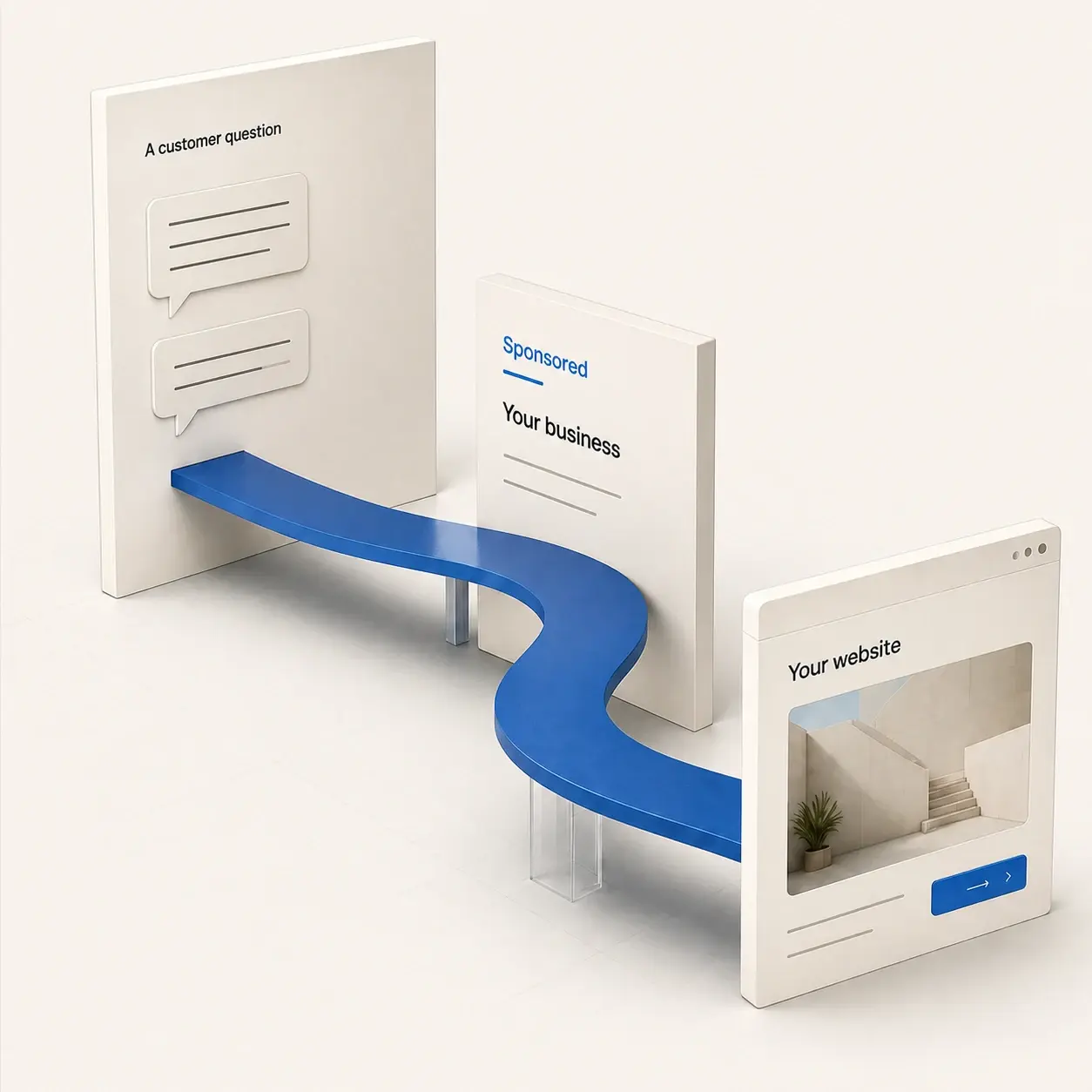
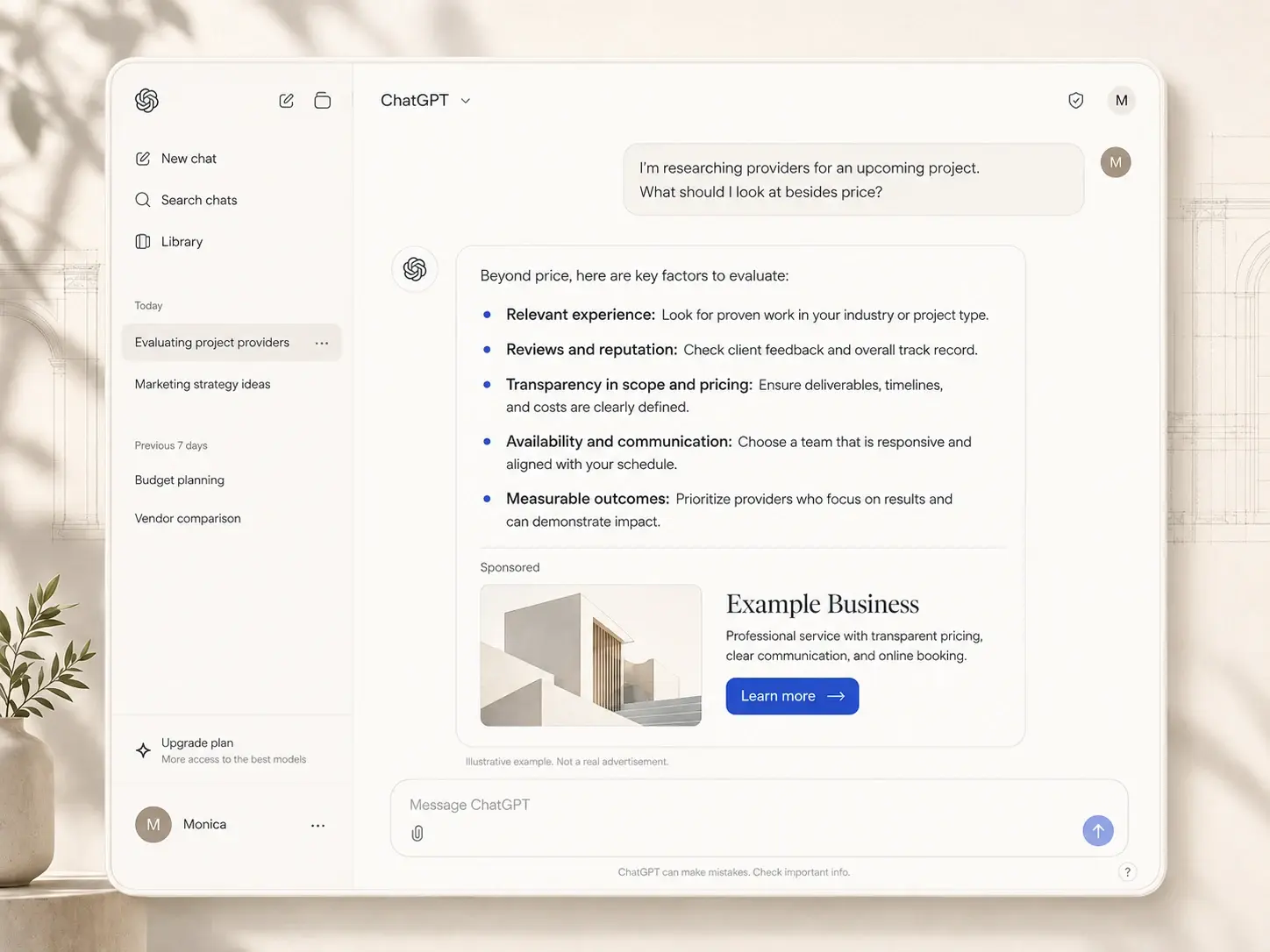
Sponsored placements that can appear below the end of a ChatGPT response, clearly labelled and visually separated from the answer. They are bought through OpenAI’s Ads Manager and shown to users on the Free and Go plans.
Traditional search advertising
A short query carries little. “furnace repair vancouver” gives you the service and the city.
Conversational advertising
A conversation carries the problem, the constraints, the urgency, and what has already been ruled out.
Advertisers do not get conversations. OpenAI states it does not share chats with advertisers and never sells user data to them, and that advertisers have no access to chats, chat history, memories or personal details. What comes back is aggregated, non-identifying performance data such as views and clicks. Any customer situation described on this page is an illustration, not something we can read, buy or export.
Five inputs are weighed together. Only the first belongs to the person having the conversation. The other four are yours to set, which is where the work actually lives.
What the person brings
Conversation context
The topic and intent of the current chat.
What you control
Context hints
Plain-language descriptions you supply of the situations where your service is relevant. Not exact-match keywords.
Your landing page
Its content is a ranking input, so page relevance is part of targeting, not just conversion.
Ad title and copy
Read for relevance against the conversation.
Targeting selections
Geography and the other controls set in Ads Manager.
Weighed together
Relevance to this conversation
If the match is close enough, a sponsored placement may appear below the answer. If it is not, nothing shows and nothing is charged.
Four of the five inputs are yours. That is the part we work on.
Because the landing page is itself an input, a weak page does not just convert badly here. It reduces how often you are shown at all.
Availability and fit
As of 28 September 2026, Canada is one of 63 countries where OpenAI’s self-serve Ads Manager is open, so Canadian businesses can hold their own advertiser account rather than routing spend through another country.
What we will not do is quote a Canadian cost per click or cost per lead. OpenAI publishes no benchmark for either, only a recommended starting bid, and any agency showing you one is extrapolating from another market or inventing it.
Geography is a targeting control, so a business can run against the areas it can genuinely reach rather than paying to appear across a province it cannot cover. For a trades company that might be the North Shore and the Tri-Cities. For a dealership it is wherever someone will drive from.
We are in Vancouver and most of our work is across Metro Vancouver, but this is not limited to local services. If you sell nationally, the same discipline applies at a wider radius.

The businesses this suits are the ones where customers describe a problem before they choose a supplier. A failed furnace in February, a roof after a windstorm, a car search that runs for weeks.
Restricted categories exist and vary by market. Financial services, health and similar verticals need eligibility confirmed against current OpenAI advertising policy before anything is built, not after.
Last reviewed against OpenAI documentation: August 2026.
Why us
Nobody has years of ChatGPT Ads history, and any agency claiming otherwise is describing a platform that did not exist yet. What the channel actually demands is unchanged: know the economics, build the conversion path, measure the outcome, and stop when the numbers say stop.
Those are the disciplines we already run for Google and Meta. The placement is new. The arithmetic is not.
Campaign strategy and media economics: what a customer is worth, what you can afford to pay for one, and what happens when that changes.
Paid GrowthLanding pages built around the action that matters. On this channel the page is also a targeting input, so it is not decoration.
Web DevelopmentAnalytics, attribution and lead quality. Knowing which leads became work, and being straight about where the data runs out.
Business SystemsHow AI discovery differs from conventional search, and why the earned side and the paid side are not interchangeable.
SEO & Search VisibilityUnit economics before unnecessary spend. Thirty years of operating experience says most channel decisions are arithmetic, not fashion.
AboutBuilt for businesses today
We are building our own tooling for this channel rather than renting someone else’s. It is designed so a business running a single account gets a small set of controls that make sense, while an operator running several is not pushed into a different product later.
That work is in progress. The service described on this page does not wait for it, and nothing here depends on it shipping.
How we work
Opportunity and eligibility
Before any money moves: the business objective, whether the category is permitted under current OpenAI policy, the geography, the economics, and whether the landing path can carry traffic. Some businesses fail this stage and we say so.
Conversational research
Not keyword lists. The situations, problems and decision moments where your service is the sensible answer, written as the context hints the platform actually consumes.
Campaign structure
Campaign and group structure, context hints, geography, budget and bidding, built so results can be read cleanly rather than as one undifferentiated blur.
Genuinely different angles
Price and value, speed, expertise, local availability, convenience, confidence. Not ten rewrites of one sentence, which teaches you nothing.
Continuity to the page
Then the practical work: offer, speed, mobile, trust, call path, forms. The landing page is a targeting input here, so this is not optional polish.
Spend through to revenue
Instrument as much of the chain as your systems allow, from spend to booked work, and be explicit about where measurement stops.
On business outcomes
Toward qualified leads, customers, acquisition cost and revenue. Not toward click-through rate, which is the easiest number to improve and the least useful one to report.
Read this
Buying ChatGPT Ads does not make ChatGPT recommend your business. In OpenAI’s own words, ads “run on separate systems from our chat model, and advertisers have no ability to shape, rank, or alter ChatGPT’s responses.” Ads appear below an answer, labelled as sponsored and visually separated from it.
Earned · AI visibility
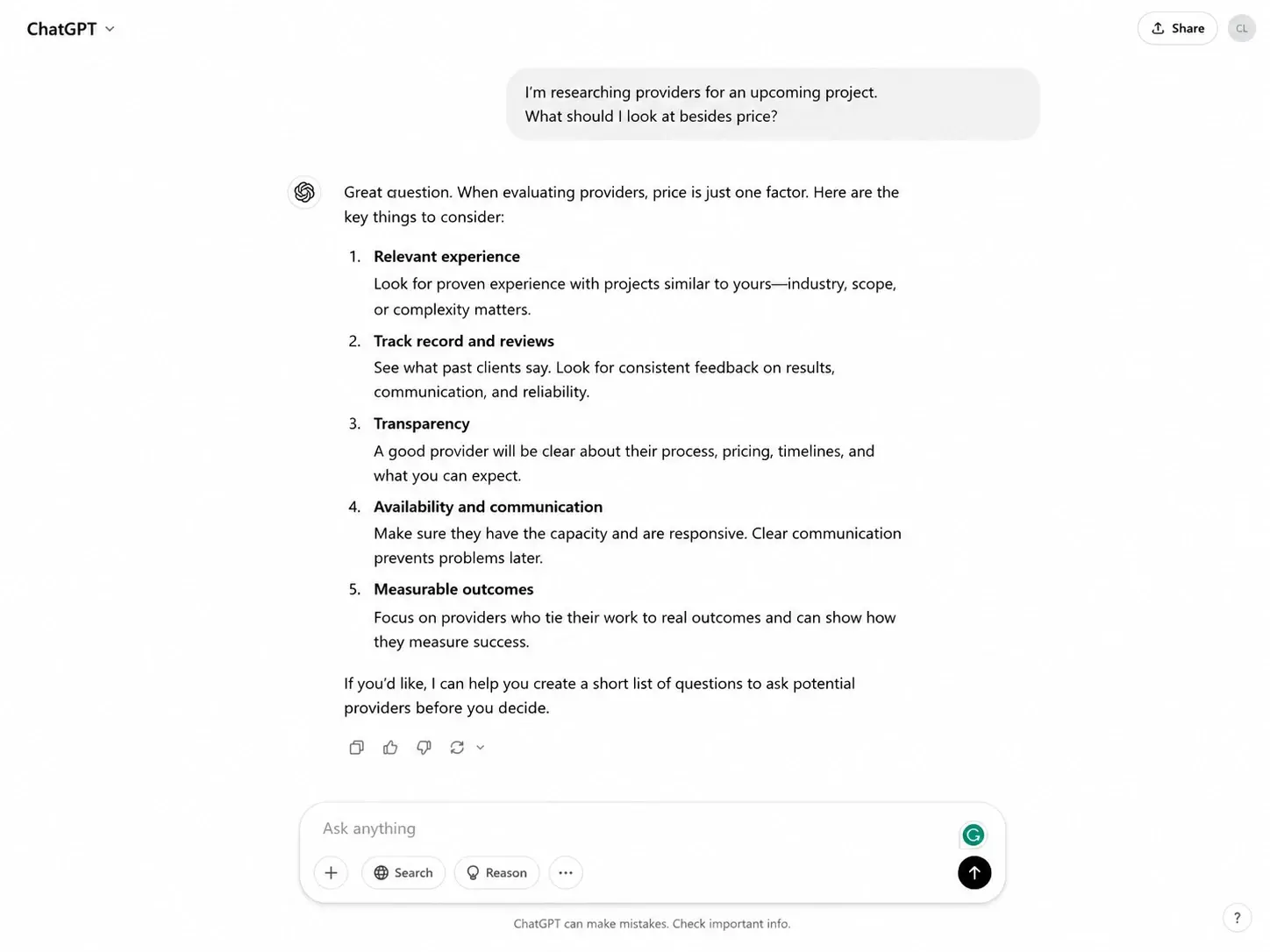
Helping AI systems understand, trust and correctly cite your business when it answers a question. Technical SEO, entity clarity, structured content, local search and authority. It cannot be bought, and it compounds.
How we work on organic AI visibilityPaid · ChatGPT Ads
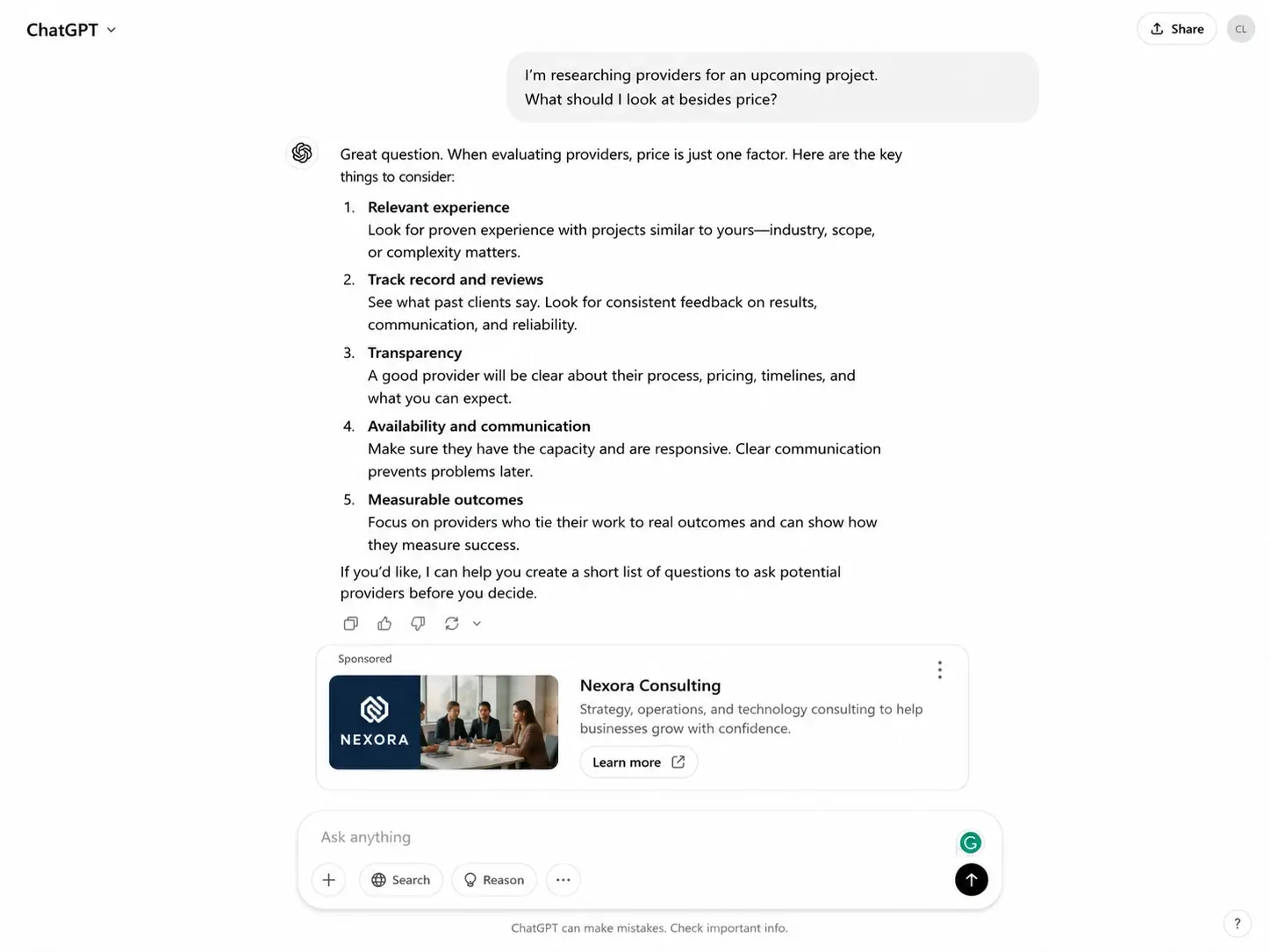
Sponsored placements shown alongside relevant conversations, bought through OpenAI’s Ads Manager. Predictable, testable and switchable off. It buys presence at the moment of research, not editorial endorsement.
How the paid side worksIllustrative examples. The advertiser shown is fictional and the placement is not a real advertisement.
You can earn the first.
You can buy the second.
You cannot buy the first.
Look at the two screens above: the answer is word for word the same. The only difference is the labelled unit underneath it. That is the whole relationship between paid and organic on this platform, and it is why nobody can sell you a better answer.
We work on both sides. They are different disciplines with different timelines, and a business usually needs the earned side working before the paid side is worth scaling.
The difference
Google Search
Three words. You know the category and the city. You do not know the budget, the timeline, what they have already tried, or what they are actually trying to fix.
Signals available
ChatGPT
“I’m looking for a Vancouver company to help us attract more customers. We need someone who understands paid acquisition, measurement and our local market. What should we compare?”
The same person, describing the situation instead of compressing it. The request now carries the constraints that decide whether a business is a fit.
Context present
Illustrative comparison of how much context a conversation carries compared with a short query. It is not a description of targeting controls available in Ads Manager, and advertisers never receive the conversation itself.
Channel comparison
Neither is universally better. Google Ads is the mature channel and for most businesses it stays the foundation. ChatGPT is interesting earlier, while someone is still working out what they need.
Demand
Google Ads. Captures demand already being searched for
ChatGPT Ads. Reaches people working a problem out
Signal
Google Ads. A short query, often two or three words
ChatGPT Ads. A described situation with constraints and urgency
Maturity
Google Ads. Two decades of benchmarks and tooling
ChatGPT Ads. Early. No stable public benchmarks yet
Audience
Google Ads. Effectively everyone who searches
ChatGPT Ads. ChatGPT users on the Free and Go plans
Best role
Google Ads. The dependable base of most paid programs
ChatGPT Ads. A tested addition where research is conversational
Illustration, not data we receive
“Our furnace stopped overnight in Burnaby and we have young kids. Can someone come today, and roughly what does it cost?”
A search box would have received “furnace repair burnaby”. The described version carries urgency, location, household context and a price question. That difference is the whole argument for the channel.
To be explicit: this is an invented example of the kind of intent the system can act on. Advertisers do not receive conversations, and we cannot read, buy or export them.
Deliverables
Four artefacts, not four adjectives. This is the analysis and structure behind a campaign, and what we walk through with you.
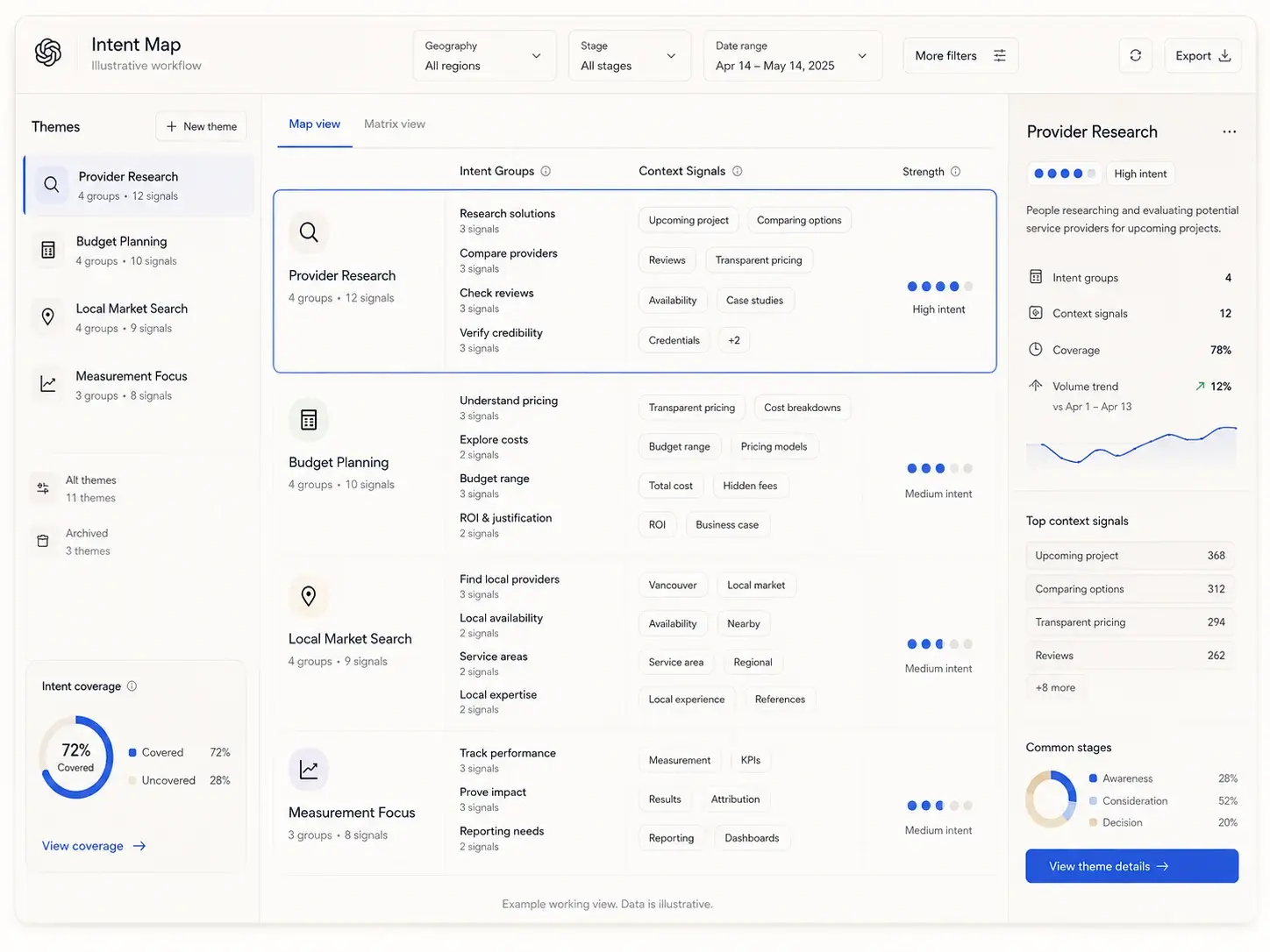
The situations your customers describe, grouped into themes we can write context hints against.
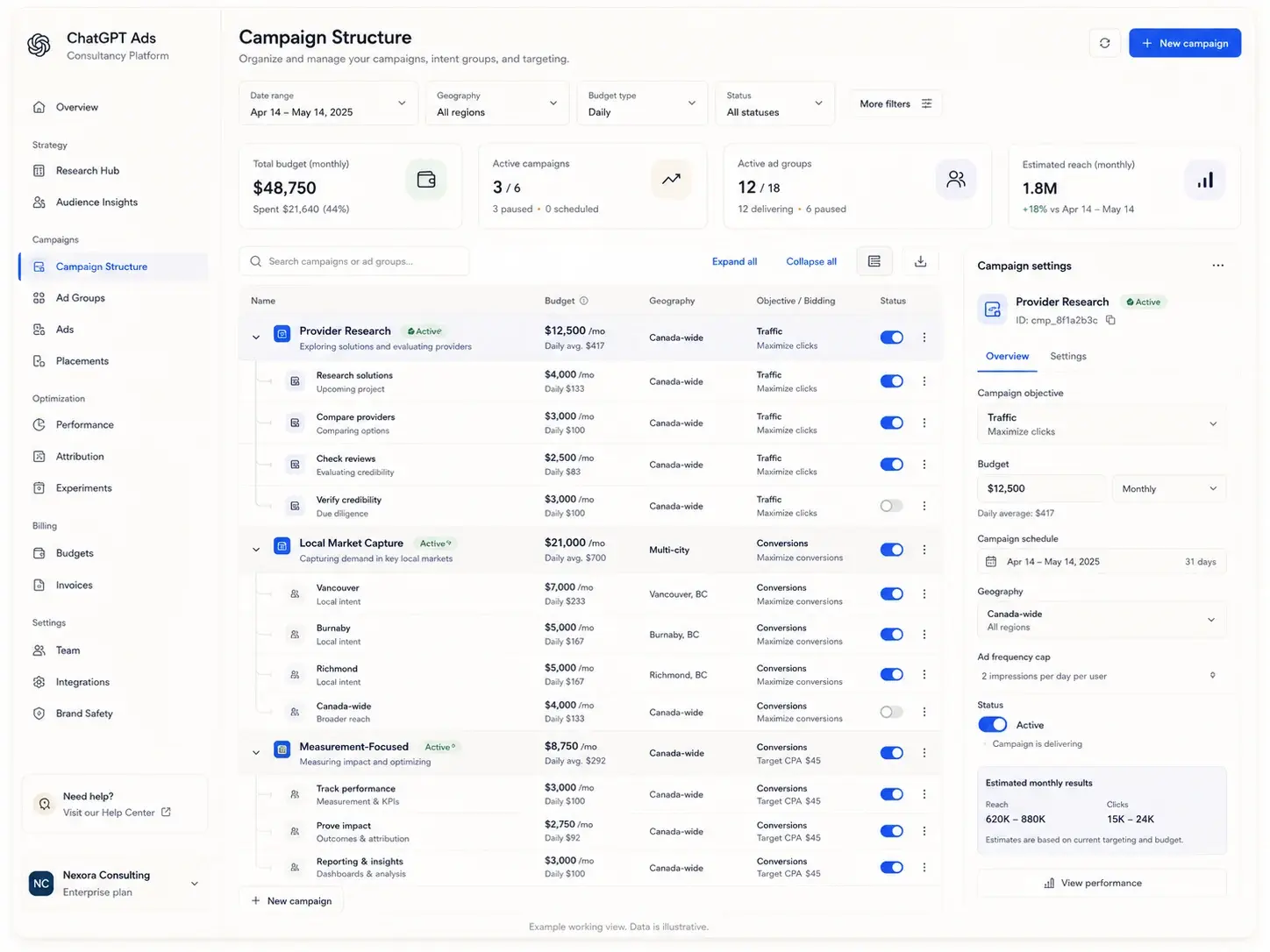
Structure built so each theme reports separately, which is what makes the results readable later.
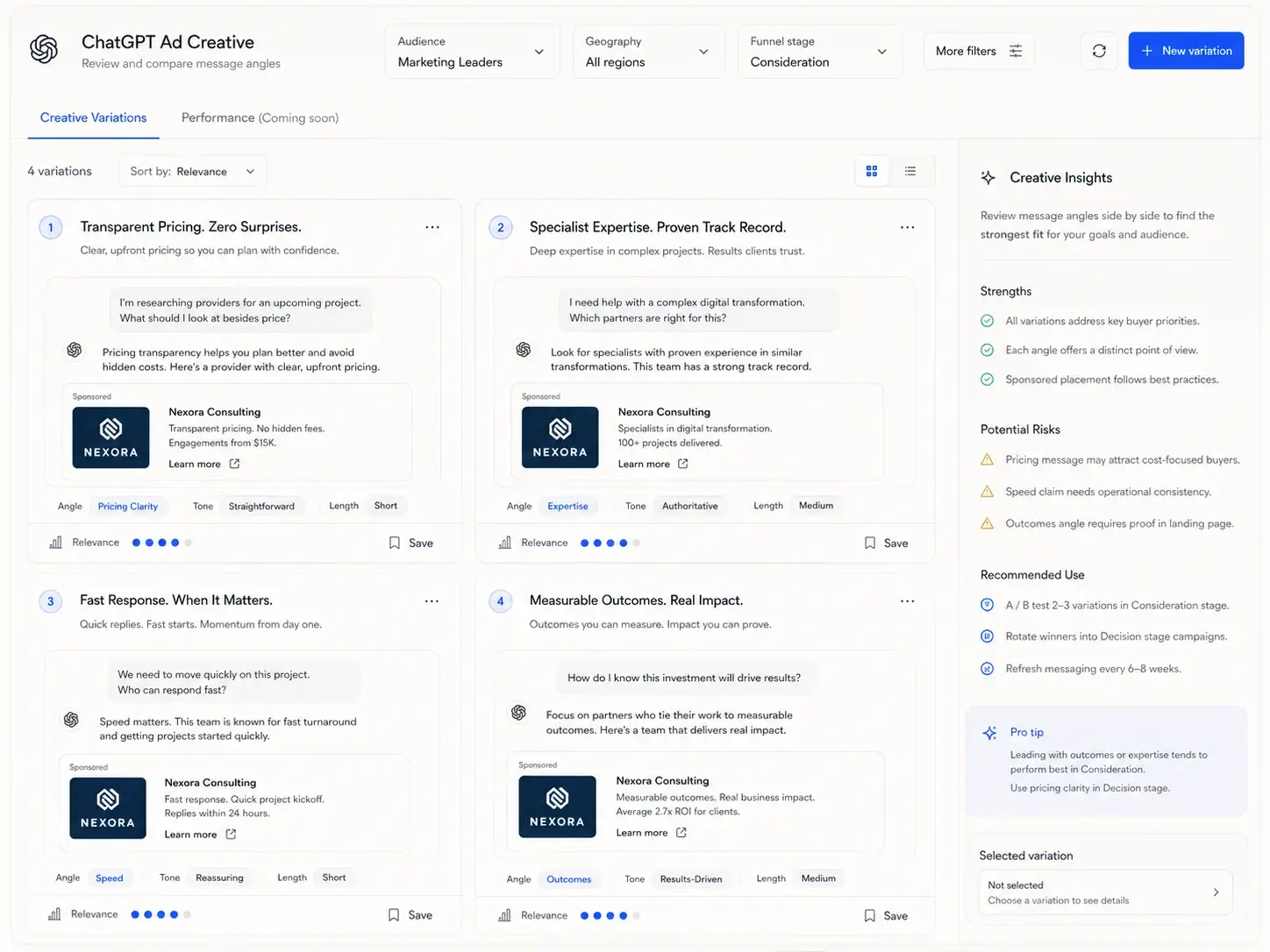
Distinct angles rather than reworded duplicates, so a losing test still teaches you something.
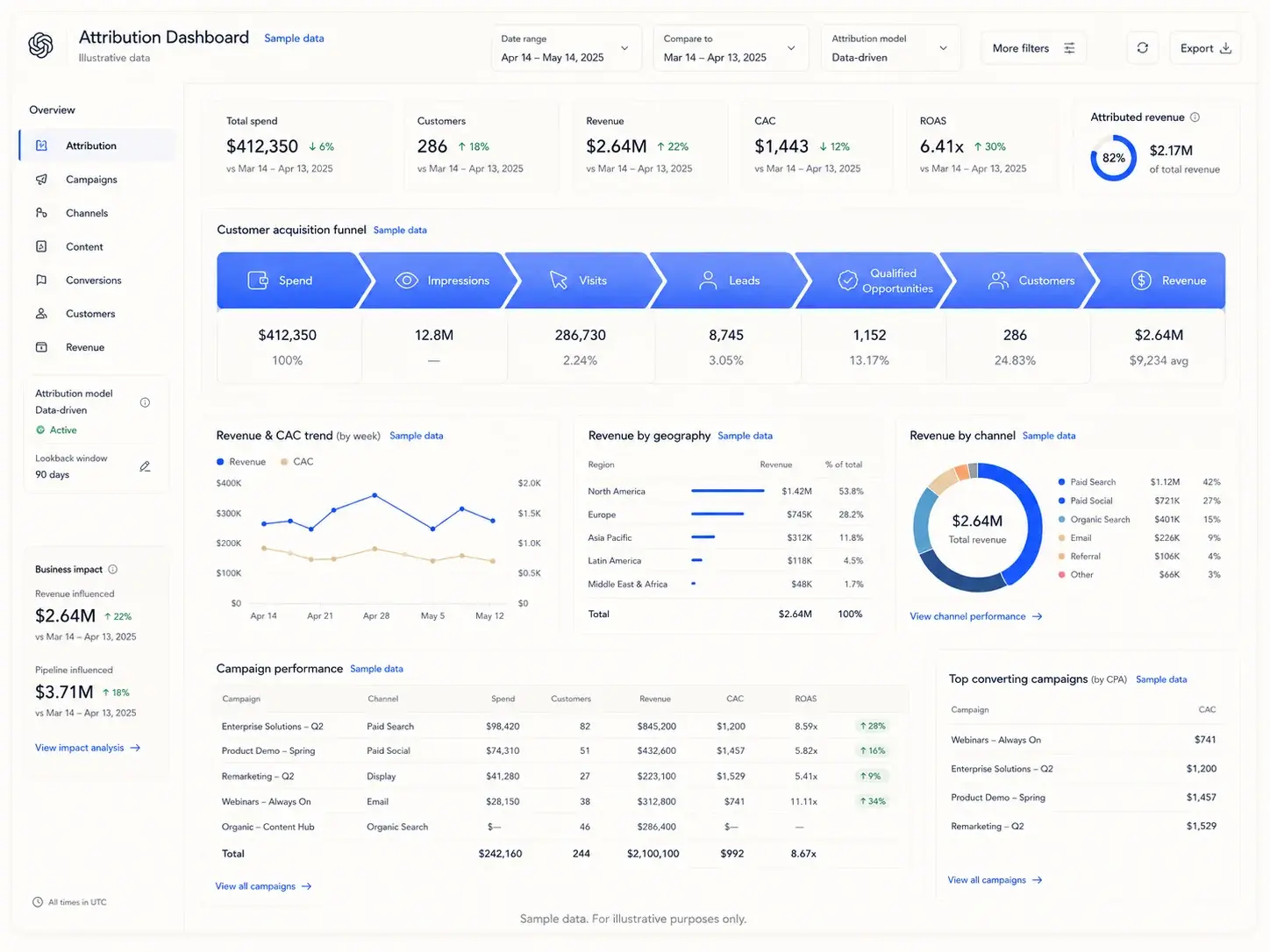
The chain from spend to booked work, with the point where measurement stops marked honestly.
Illustrative working views. Every figure shown is sample data, not client results. These represent the analysis, structure and reporting we produce; the tools used to assemble them vary by engagement and by what your own systems already support.
Measurement
A new channel makes cheap clicks easy to celebrate. Advertising matters when it creates commercially useful outcomes, and those sit further down the chain than any ad platform reports.
Spend
Budget committed
Impressions
Placement shown
Visits
Click through to the page
Leads
Call, form, booking
Qualified opportunities
Real, in-area, in-scope
Customers
Work actually won
Revenue and acquisition cost
What the channel is worth
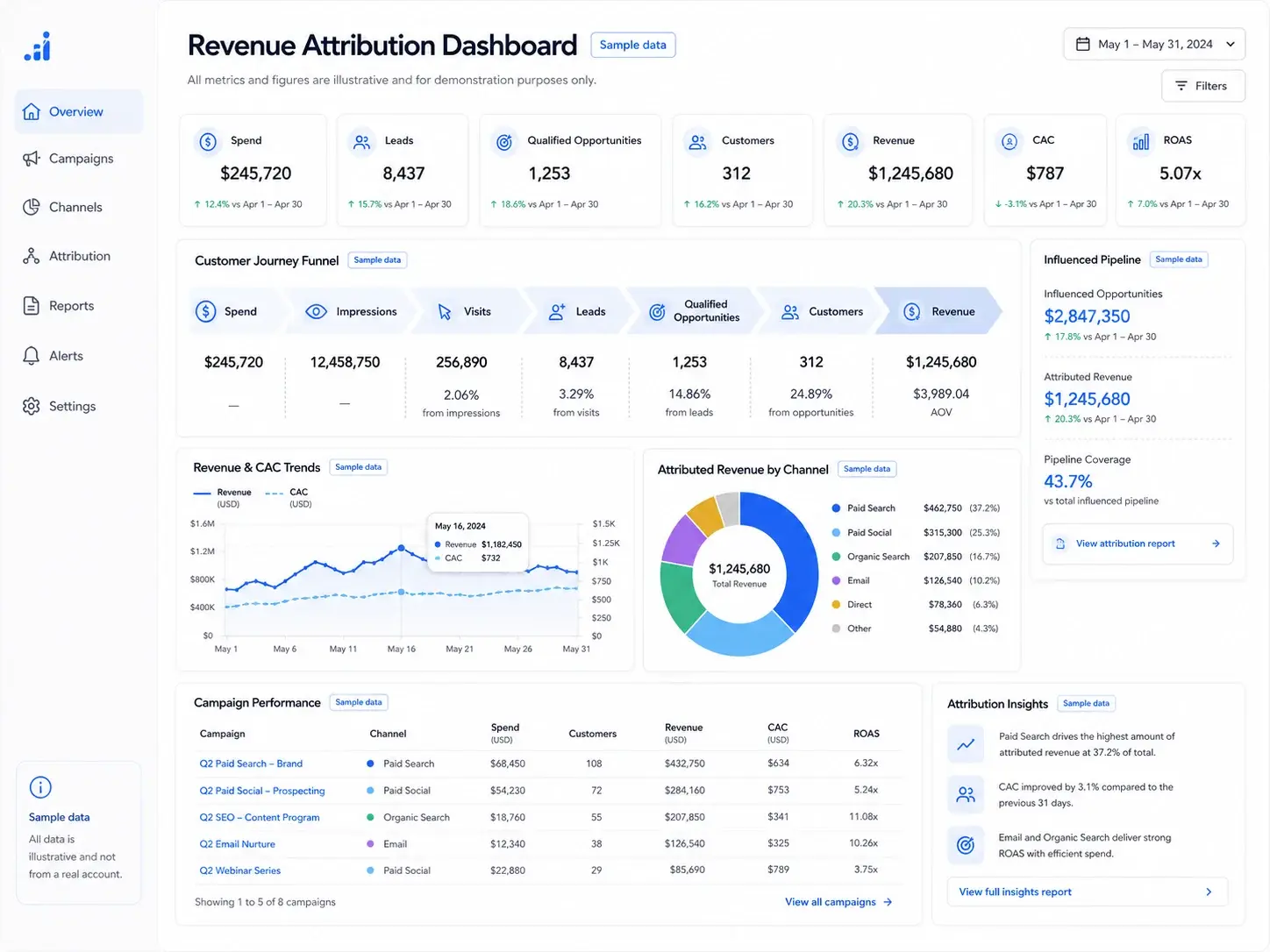
Illustrative data. We do not publish client figures without documented approval.
We instrument as much of that chain as your systems genuinely allow. With call tracking, form capture and a CRM we can usually follow spend through to booked work. Without them we are honest about where the measurement stops, and we fix the gap before scaling rather than guessing across it.
We connect advertising performance to the business outcomes we can reliably measure. Where we cannot measure something, we say so.
Getting started
We do not recommend moving budget off a channel that works simply because a new platform exists. The sensible move is a contained test with real measurement attached, sized so that being wrong is affordable.
ChatGPT Ads · controlled pilot
Category, policy, geography and economics.
The situations worth showing up in.
Structure and genuinely different angles.
Continuity to the page, measurement in place first.
Contained budget, defined end date.
Lead quality, not lead count. Then stop or scale.
Fixed before launch
If the assessment says your category is restricted, your customers are not on the free plans, or your landing path cannot carry the traffic, we will tell you that instead of selling you a pilot.
Scope and fees are set per business once the assessment is done. We will not quote a number before we know what we are quoting for.
Read before you spend
Everything below traces to OpenAI’s own documentation, with the date it was last checked. Where something is not published, we say so rather than filling the gap with a number.
Availability
Whether you can run these at all from Canada, who actually sees them, and what has to be in place before anything goes live.
Cost
How billing actually works across the three objectives, why the daily budget is an average rather than a cap, and why no honest Canadian benchmark exists yet.
Comparison
Not a winner-takes-all comparison. What each channel is genuinely good at, and the audience limitation that decides it for most B2B businesses.
Targeting
Why they are not keywords, what OpenAI says they explicitly cannot do, and how to write them as situations instead of match types.
Measurement
The Pixel, the Conversions API, the oppref click reference and deduplication, plus where platform measurement stops and your CRM has to take over.
Questions
Last updated , checked against OpenAI’s ChatGPT Ads documentation.
Sponsored placements that can appear below the end of a ChatGPT response, each with the advertiser's name and logo, a headline, a short description, an image and a landing page. They are labelled as sponsored, visually separated from the answer, and bought through OpenAI's Ads Manager. They are shown to users on the Free and Go plans and to logged-out visitors, never on Plus, Pro or Business plans.
Yes. Canada is one of 63 countries where OpenAI's self-serve Ads Manager is open as of September 2026, so Canadian businesses can run their own advertiser account, billed in Canadian dollars with a minimum daily budget of $25 CAD. The platform is still in beta and changing monthly, so we confirm current status before starting anything.
Yes. Geography is a targeting control down to regions, cities and postal codes, so a Vancouver or Lower Mainland business can run against the areas it actually serves rather than paying for the whole country.
No, and this is the single most important thing to understand about the channel. OpenAI states that ads run on separate systems from the chat model and that advertisers have no ability to shape, rank or alter ChatGPT's responses. Buying ads gets you a labelled sponsored placement, never a change to the organic answer.
No. Being cited in the answer itself is earned visibility, and it comes from the work that makes your business understandable and trustworthy to AI systems: technical SEO, entity clarity, structured content and authority. That is a different service, and for most businesses it is the one that compounds.
Plain-language descriptions an advertiser provides of the topics, needs and situations where their product or service is relevant. The system matches them against the current conversation. They are not exact-match keywords, and writing them well is closer to describing your ideal customer's problem than to building a keyword list.
The ads system considers the context and intent of the current conversation, your context hints and targeting selections, your ad title and copy, and your landing page content, then runs a relevance-weighted auction. Targeting selections now include geography, platform (iOS, Android and desktop, app or web) and custom audiences built from your own customer lists. Because the landing page is an input, a weak page reduces how often you are shown, not just how often you convert.
No. OpenAI states that it does not share conversations with advertisers and never sells user data to them, and that advertisers have no access to chats, chat history, memories or personal details. Advertisers receive aggregated, non-identifying performance data such as views and clicks.
We set that during the assessment rather than publishing a number, because it depends on your category, geography and what a customer is worth to you. The platform minimum is $25 CAD a day. What we will not do is quote a Canadian cost per click or cost per lead benchmark: OpenAI says the platform does not yet have performance benchmarks, and the only figure it gives, a recommended starting bid of $3 to $5 USD per click, is where to begin bidding, not what a lead costs.
As far as your systems allow. With call tracking, form capture and a CRM in place we can usually follow spend through to booked work and revenue. Where that infrastructure is missing we say where measurement stops, and we would rather fix that gap before scaling than estimate across it.
No, and neither is the reverse. Google Ads captures demand people are already searching for and remains the dependable base for most businesses. ChatGPT reaches people earlier, while they are describing a problem and weighing options. For most Vancouver businesses the sensible position is Google as the base and ChatGPT as a measured test alongside it.
Businesses whose customers describe a situation before choosing a supplier: home services, automotive, considered retail, travel. It fits less well where buying is instant and undifferentiated, and it is limited for B2B, because ads are not shown on Plus, Pro, Business, Enterprise or Edu accounts and many professional users sit on those plans.
A lot, in September 2026 alone. The platform opened to 63 countries, conversion campaigns can now bill per impression as well as per click, attribution windows became adjustable (7, 14 or 30 days after a click, plus an optional day after a view), and advertisers gained platform targeting, custom audiences, shopping ads from a product feed, and Shopify and HubSpot integrations. Sponsored Agents, where an ad opens a chat with a business's AI representative, is in a closed alpha. Our ChatGPT Ads guides each carry the date they were last checked against OpenAI's documentation.
Yes. We handle eligibility assessment, conversational intent strategy, campaign build, context hints, creative, landing path, conversion measurement and ongoing management. We start with an assessment, and if the channel does not suit your business we will tell you rather than sell you a pilot.
Next step
We will look at whether your category is eligible, whether your customers are reachable on this platform, and what it would take to measure a test properly. If the answer is that it does not fit yet, that is a useful answer too.
Is ChatGPT Ads worth testing?
We assess the economics before recommending the spend.
Insights
Buying AI services
Fixed-price vs. retainer: how to buy AI services in 2026Why monthly retainers became the default, and why most operators are better off without them. An honest comparison from an operator who has bought, sold, and run both models.6 min readWhat things cost
How much should a Vancouver business spend on Google Ads?A practical way to set a Vancouver Google Ads budget from economics, click costs, conversion rates and sales capacity.9 min readWhat things cost
ChatGPT Ads in Canada: what businesses need to know in 2026ChatGPT Ads is open to Canadian businesses. Who sees the ads, what you need before one runs, what changed in September 2026, and what nobody can tell you yet.8 min readBrowse the full library:The Field GuideBuyer GuidesAI by Industry
Start here
We assess whether the channel fits your business before anyone spends money on it. If it does not fit, we will say so.
5.05 out of 5.10 Google reviews
Prefer to talk? (250) 581-0523 or [email protected]